Wednesday, April 24, 2013

The Poster, The Poser.

A. Nick and I have been talking about doing an event poster for some time now. A talented artist, you've seen his illustrations gracing his rec cards, and he also recently did a cover for Alcoholmanac magazine. After our first attempt with Jasper Fforde (the best laid plans...), Nick struck event poster gold with his second, a beautiful rendition of Peter Heller's The Dog Stars.

The Dog Stars was one of our favorite novels of 2012, and we're just thrilled to be hosting the author for his paperback tour on Wednesday, June 19, 7 pm. Our friend Kate laid it out for us--we bettter do a good job, or else. I wonder why more publicists don't use that sort of argument?

We started off by giving Heller an opening author in Ethan Rutherford, whose new collection, The Peripatetic Coffin, has several booksellers in ecstasy. Now we've got several folks helping out in Team Heller (and what do you know, Kate and Ethan once worked together, and that was totally not on purpose).

And then Nick and I started brainstorming again about a poster. We really want to put posters up in alternate venues, but we wanted something that was not our run-of-the-mill event poster. Don't get me wrong, I love our posters! It's just that this is a work of art. More on this as the date draws near.

B. After a lovely day driving around with Elinor Lipman for The View from Penthouse B, I'm feeling like everything should be downhill from here, but it wasn't exactly, as tonight's event with Fiona Maazel was lovely, and at Stacie's suggestion, we presented her with cheese curds as a thank you for visiting on her Woke Up Lonely book tour.

The Lipman lunch was lovely, by the way. So many devoted readers, and at the end of the day, we went to dinner at Wolf Peach with our old friend Nancy, who ran around the hall handselling copies of Lipman's essays, I Can't Complain.

I was asked to introduce the author, and being that this wasn't just an evening at the store and my two sentences, I actually wrote something out, but of course there was also a bit of improv too. My thought was that so often what we remember most about authors is not their work but our relationship to it, how we came to read it, what affect it had on us. This theory was borne out with several discussions that Lipman had with her fans.

For me, I remembered how our colleauge Jeanne was obsessed with Then She Found Me and called into a radio show to ask Lipman a question, after the other authors started hogging the airwaves. I remembered that I met Lipman at a pub party for The Way Men Act, and she first came to Milwaukee for Isabel's Bed, and I should note, returned for every novel since.

A few weeks ago my friend John posted a twenty-year-old picture of me reading The Way Men Act, which I always thought was a funny photo, as I have never really figured gotten a handle on that statement. But I also thought it would be nice to revisit the novel, and while I always tell folks that we never have time to read at work, I should note that it was the end of a long day and I was off the clock.

I tried to remember what book matched up with which adventure. The bookseller dinner at Mader's. Another at Bartolotta's with Anita Shreve. The Bacchus lunch. Events at the Shorewood, Brookfield, and Mequon Schwartz stores. But after that first visit, I only remembered our ribbon cutting with Shreve and Mameve Medwed, after which the three authors went out to dinner with my celebrating family. But I'm counting on someone to chime in and much up the other visits.

Tuesday, April 23, 2013

New Boswell's Best Titles from newcomers Helene Wecker and Bee Ridgway, Plus Old Pros Isabel Allende and Edward Rutherfurd.

It's time for our weekly (not always) wrap up of brand new (not always) books at Boswell. This week I'm focusing on fiction Boswell's Best titles.

One of the highest profile new releases this week is Isabel Allende's new novel, Maya's Notebook (Harper), which is a change-of-pace contemporary novel for this noted author. Maya Vidal is a 19-year-old living off the coast of Chile, having dodged a downward spiral of drugs, alcohol, and petty crime. Agnes Torres Al-Shibibi in the San Francisco Chronicle praises the "beguiling mix of clear-eyed toughness and lightness of spirit."Some of the advance trade reviews were negative while others were glowing; they say it's better to have an impact on a reader than leave one cold.

The Golem and the Jinni, by Helene Wecker (Harper) has had some buzz among booksellers, as well as earning buzz book designation from The Huffington Post, which is comparing it to The Night Circus. The golem is brought to New York from a Polish shtetl, while the jinni arrives from the Syrian desert. Publishers Weekly called it "spellbinding blend of fantasy and historical fiction." Wecker tells a little more about her life in this column, "The Most Jewish Thing I Do" in The Jewish Daily Forward

Another debut with some enthusiasm behind it is Bee Ridgway's The River of No Return (Dutton). A soldier about to die on the Napoleonic battlefield wakes up in modern London, learning that he's working for the Guild, allowing him to travel through time. He's asked to go back and fight the Guild's enemies and find the Talisman. Kirkus notes that "bookish fantasy fans who make it a point to keep up with Doctor Who will like this one." Now that you mention it, I think that Dr. Who is influencing contemporary novels like never before. What do you think?

It's hard to believe that Edward Rutherfurd has yet to have a novel called Paris, (Doubleday) but that is the case. Rutherford seems to have taken the mantle of James Michener, with novels set in London (also England), Dublin, Russia, and New York, all multi-generational extravaganzas. The Booklist reviewer was angling for good quotable copy, as how else can I explain "Anyone who has ever visited Paris or desires to do so will definitely want to dig into this movable feast."

Mr Rutherfurd has a trailer for his new book. I'd be remiss if I did not include it here!

Monday, April 22, 2013

A Week of Great Events! Thomas Dyja, Fiona Maazel, Brian Kimberling, Chris Fink, Plus Don't Forget About Michael Pollan.

I am very excited to have this innovation in listing the week's events--we now include a preview of next Monday's event. Otherwise the Monday event can listed a little last minute for my taste. And now they get two listings. No more Monday prejudice, but Tuesday is rather pissed at me.

We have Elinor Lipman coming on Tuesday for the Friends of the Milwaukee Public Library literary lunch. While it's too late to get tickets, the good news is that we can still get you a signed copy of one of her books. Give us a call at (414) 332-1181 if you'd like something autographed.

Monday, April 22, 7 pm, at Boswell:
Thomas Dyja, author of The Third Coast: When Chicago Built the American Dream.

Chicago-native Thomas Dyja offers a cultural history of the Windy City at midcentury and how its incredible mix of architects, politicians, musicians, writers, entrepreneurs, and actors helped shape America’s culture and identity.

From the architecture of sky-grazing buildings, the tentacle-spread of fast-food chains, and the personal dramas taking place in housing projects, to the dominance of rock and roll, the roots of literature and entertainment, and beginnings of the new labor movement, Chicago’s unique intermingling of race, class, and politics ushered the unparalleled creativity and innovation that made Chicago “the third coast” in post-war America.

Dyja argues that understanding America requires understanding beyond the east and west coasts, and that it’s important to restore the central place of cities like Chicago – and their considerable contributions to our culture – to their central place in our history. It is, he says, “a crucial step towards reassembling a nation that has lost its shared sense of identity and experience.”

Rachel Shteir reviews Thomas Dyja reviews on the front page of The New York Times Book Review here.

Wednesday, April 24, 7 pm, at Boswell
Fiona Maazel, author of Woke Up Lonely, with opening reader Mollie Boutell Butler.

Fiona Maazel’s first novel, Last Last Chance, was called "moving, buoyant, and utterly true" by The New York Times Book Review. She is winner of the Bard Prize for Fiction, a National Book Foundation "5 Under 35" honoree, and a Lannan Foundation fellow.

Thurlow Dan is the charismatic founder of the Helix, a cult based on the idea that everyone is lonely and that the only way to avoid emptiness is through connection. They sponsor speed-dating, rallies, communes, and a Facebook-like website designed to prevent loneliness via oversharing. But Thurlow, camped out in his Cincinnati headquarters, is lonely. And his ex-wife, CIA covert agent Esme, is the only one he wants. Through a series of well-intentioned missteps in the name of earning back Esme’s love, Thurlow finds himself at the center of a hostage situation with nowhere to run.

Maazel takes us down the rabbit hole of what it means to be lonely in the age of the internet, in which none of us are ever truly alone. Fans of Sam Lipsyte, Jennifer Egan, Lauren Groff, and Karen Russell will find much to love in Woke Up Lonely, which is by turns comic, lacerating, heartbreaking, and wholly unpredictable.

Andrew Russeth reviews Maazel in The New York Observer.

Thursday, April 25, 7 pm, at Boswell
Brian Kimberling, author of Snapper, with opening reader Alex Picket.

Brian Kimberling grew up in southern Indiana and spent two years working as a professional birdwatcher before living in the Czech Republic, Turkey, Mexico, and now England. He received an MA in creative writing from Bath Spa University in 2010.

Nathan Lochmueller studies birds, earning just enough money to live on. He drives a glitter-festooned truck, the "Gypsy Moth," and he is in love with Lola, a woman so free-spirited and mysterious she can break a man's heart with a sigh or a shrug. Around them swirls a remarkable cast of characters: the proprietor of Fast Eddie's Burgers & Beer; the genius behind "Thong Thursdays;” Uncle Dart, a Texan who brings his swagger to Indiana with profound and nearly devastating results; a snapping turtle with a taste for thumbs; a German shepherd who howls backup vocals; and the very charismatic state of Indiana itself. And at the center of it all is Nathan, creeping through the forest to observe the birds he loves and coming to terms with the accidental turns his life has taken.

A wonderful rec from Boswell's own Sharon K. Nagel:
"Snapper is a series of connected non-linear short stories about a guy named Nathan who watches birds for a living in Indiana. If that description doesn’t make your heart beat faster, read this book anyway. Brian Kimberling will change your mind about what makes for exciting and fun storytelling.

Listen to Kimberling read an excerpt of Snapper here!

Read Kimberling's essay, "What Do Birders Know?" in The New York Times.

Friday, April 26, 2:30 pm, at Cramer Hall, Marquette University, 604 N. 16th Street:
Katherine Preston, author of Out with It: How Stuttering Helped me ind My Voice.

This event is sponsored by the Milwuakee chapter of the National Stuttering Association.

A fresh, engaging account of a young woman's journey, first to find a cure for a lifelong struggle with stuttering, and ultimately to embrace the voice that has defined her character. It offers a fresh perspective on the obsession with physical perfection.

"Katherine Preston is an upbeat and inspiring example of how to deal with a problem that concerns so many and yet is acknowledged by so few. Out With It deserves the widest possible audience."
--Michael Palin, actor, author, and founder of the Michael Palin Centre for Stammering Children

Friday, April 26, 7 pm, at Boswell:
Chris Fink, author of Farmer's Almanac: a Work of Fction.

Chris Fink is a professor at Beloit College in Wisconsin,where he teaches literature, creative writing, and journalism. He is the editor of the Beloit Fiction Journal.

In Chris Fink’s debut work of fiction, America’s rural core is cracked open to reveal moments of stark beauty and cruelty. Farmer’s Almanac—a new Midwestern Gothic—is an imaginary handbook for rural living, as timeless and essential as its namesake. But this is no American pastoral. Fink’s vision is more Orwell than Rockwell. Not since Winesburg, Ohio has a book so thoroughly plumbed the Midwestern character. A despairing farmer milks a dead cow, a baseball phenom chooses between the diamond and the dairy barn, and in the back of the school bus, a young girl fights back against her tormentors. Farmer’s Almanac reports the news from mythical Odette County, Wisconsin, where the milk prices keep falling, and the forecast is not good.

Chris Fink interviewed by the Beloit College Terrarium!

Monday, April 29, 7:30 pm, at the Oriental Theatre:
Michael Pollan, author of Cooked: A Natural History of Transformation.

This event is co-sponsored by Wisconsin Public Radio.

$30 tickets include a signed copy of Cooked: A Natural History of Transformation. A $20 Boswell gift card in lieu of book is available the night of the event only. Visit our website and follow the link to buy tickets on the Oriental Theatre website.

Michael Pollan’s books include The Botany of Desire, The Omnivore's Dilemma and In Defense of Food, all New York Times bestsellers. A longtime contributor to The New York Times Magazine, he is also the Knight Professor of Journalism at Berkeley. In 2010, Time magazine named him one of the one hundred most influential people in the world.

From the bestselling author of The Omnivore's Dilemma comes a kitchen-focused exploration of the enduring power of the four classical elements—fire, water, air, and earth—to transform the stuff of nature into delicious things to eat and drink. Apprenticing himself to a succession of culinary masters, Pollan learns how to grill with fire, cook with liquid, bake bread, and ferment everything from cheese to beer. In the course of his journey, he discovers that the cook occupies a special place in the world, standing squarely between nature and culture.

Starting with the theory that “Cooking, above all, connects us,” Pollan ventures into the kitchens of others: a North Carolina barbecue pit master; a Chez Panisse-trained cook; a celebrated baker; and finally, several mad-genius "fermentos" (a tribe that includes brewers, cheese makers, and all kinds of picklers). Arguing that by giving over this practice to corporations means we weaken not only the sustainability of our communities, but also our most social relationships—the ones we have with family and friends. By reclaiming cooking as an act of enjoyment and self-reliance, and learning to perform the magic of these everyday transformations, we can open the door to a more nourishing life.

Sunday, April 21, 2013

Sunday Bestsellers for Week Ending April 20--All Sorts of Tidbits About What's Sold This Week at Boswell.

Hardcover fiction:
1. Life After Life, by Kate Atkinson
2. Gone Girl, by Gillian Flynn
3. The View from Penthouse B, by Elinor Lipman
4. The Interestings, by Meg Wolitzer
5. Z, by Therese Anne Fowler

I mentioned on a post about how their is this slew of high-profile releases by women in April, seemingly because April is an important publishing month, but also because I think there's an obsession with a gift pop for Mother's Day. And that leaves us with a top five sweep for female authors. My only confusion? Aren't women the majority of readers all year long, not just when they are the specific gift receivers?

We had a slowish start with Therese Anne Fowler's Z, but after seeing not just a New York Times pop, but a astrong presence on the Indie Next bestseller list (from other indie bookstores), we beefed up our stock and gave it a place on the Boswell's Best, and we're now getting a steady sale. The author's reviews seem heavily weighted towards Australia and New Zeland on initial searches--here's a piece from Anita Sethi in the Sydney Morning Herald. I don't know why this is. However, I do know that all the Zelda novels are a conflagration of two forces--the release of the new "Great Gatsby" movie and success of other novels featuring wives of famous figures.

Hardcover nonfiction:
1. Dead Run, by Dan Schultz
2. Gulp, by Mary Roach
3. Lean In, by Sheryl Sandberg
4. Salt, Sugar, Fat, by Michael Moss
5. The Little Paris Kitchen, by Rachel Khoo

Another great week of events included Kate Atkinson on Friday (#1 fiction hardcover), and the Dan Schultz (#1 nonfiction hardcover) Maguire (#1 nonfiction paperback). I learned that Mr. Schultz was a former bookseller, having booked events at Explore Booksellers in Aspen.

Meanwhile, Michael Moss's Salt, Sugar, Fat continues to sell well. Hannah Wallace in The New York Times notes: "If you had any doubt as to the food industry’s complicity in our obesity epidemic, it will evaporate when you read this book."

Paperback fiction:
1. Beautiful Ruins, by Jess Walter (May 6 event)
2. Where'd You Go, Bernadette?, by Maria Semple (May 1 event)
3. Started Early, Took my Dog, by Kate Atkinson
4. The Great Gatsby, by F. Scott Fitzgerald
5. The Light Between Oceans, by M.L. Stedman

The word of mouth on Beautiful Ruins is amazing. We're seeing increases in sales each week, which is not what you see for this kind of novel. We'd like to hope that some of the extra buzz is around our event with Jess Walter on May 6, but it seems well beyond that. Good job HarperCollins for not second guessing yourself on the paperback cover. Similarly Semple's publisher only did minor tweaks on the paperback jacket for Where'd You Go, Bernadette?, and this image has been so popular that a variation has been used on most of the international editions. I think I posted the Spanish version, but even the German cover jumped on the bandwagon.

The third book in the not-exactly-literary-breakout-because-all-three-hit-the-NYT-bestseller-list-in-hardcover-but-plenty-of-hardcover-bestsellers-don't-sell-as-well-in-paperback series is The Light Between Oceans, by M.L. Stedman, a book that had a slow start with us, but wound up picking up quite a bit after a bit more prompting on our part. If you missed this Marjorie Kehe interviewed Stedman in the Christian Science Monitor this past fall. This interview will be really helpful for book club meetings. Here's a teaser; you can read the whole piece on their website.

"I write very organically – a picture or phrase or voice turns up in my mind, and I just follow it. For this story, I closed my eyes and could see a lighthouse and a woman. I could tell it was a long time ago, on an island off Western Australia. A man appeared, and I sensed he was the lightkeeper, and it was his story. Then a boat washed up, carrying the body of a dead man. I kept looking and saw there was a baby in it too, so I had to keep writing to see who all these people were and what happened next."

Paperback Nonfiction:
1.  A Merry Memoir of Love, Sex, and Religion, by Daniel Maguire
2. Citizens of London, by Lynne Olson
3. Quiet, by Susan McCain
4. Milwaukee Soldier's Home, by Patricia Lynch
5. The Social Conquest of Earth, by Edward O. Wilson

It's nice to see a pop for Edward Wilson's The Social Conquest of Earth, and it feels like a whole month since we've seen a new regional title from History Press of Arcadia. Milwaukee Soldier's Home is from the later. But too me the most interesting thing on the list is the steady sales of Lynne Olson's Citizens of London, a book that has had long legs in paperback in a genre (history) that usually sees its best sales in paper, and the book club selections (we've had a number) reserved for the prize winners or the superstars of the genre.

Books for Kids:
1. Better Nate than Ever, by Tim Federle
2. The Dark, by Lemony Snicket and Jon Klassen
3. The Fault in Our Stars, by John Green
4. Goblin Secrets, by William Alexander
5. Goodnight Underwear, by Harriet Ziefert and Todd H. Doodler

Regarding Federle, it turns out that a school with a tap dance program is a good match. Regarding Alexander, you should expect more appearances here as his school sales come in. Regarding The Dark, how nice of Fresh Air to rerun Lemony Snicket's wonderful interview. And regarding Goodnight Underwear, should I bring in the bear in underwear plush or not? I can't decide.

On the front page of today's New York Times Book Review, one of the Chicago books featured is Thomas Dyja's The Third Coast: When Chicago Built the American Dream. Dyja will be speaking at Boswell tomorrow, Monday, April 22, 7 pm. Rachel Shteir observes that "Dyja zooms in on the qualities Chicagoans value and does it better than anyone else I’ve read: informality; the desire to be 'regular'; the conviction among artists that 'the process was as important as the product." Join us tomorrow.

In the Journal Sentinel, Christi Clancy reviews The Humanity Project, the newest novel from Jean Thompson, who is visiting Boswell on Wednesday, May 8, 7 pm. Her take: "With godlike power, Jean Thompson, author of The Humanity Project, throws her dented (and entirely recognizable) characters into the crucible of the American recession to reveal what it means to be human: flawed, and yet somehow worthy of redemption that comes in glimmers instead of bursts.

Carole E. Barrowman offers up this month's mystery roundup.

Sarah Graves's new entry in the Home Repair is Homicide series, A Bat in the Belfry, is "stylishly suspenseful." Needless to say, the latest entry in this Maine-set saga has our sleuths investigating a teen's death in a bell tower.

Linda Barnes takes a break from her Carlotta Carlyle series with The Perfect Ghost, a stand alone about a celebrity biographer who, after the death of her writing partner, finishes a project on her own, becoming involved with a reclusive director and, well, to paraphrase, it blew Barrowman away.

Brad Parks writes about an investigative journalist investigating the death of a policeman in The Good Cop.  Barrowman calls it "a charming first-person mystery punctuated with big doses of humor."

And I should also note that Jim Stingl profiles Jayne Jordan, whose new book, This Token of Freedom, chronicles her journey from war-torn Europe to Fox Point.

Friday, April 19, 2013

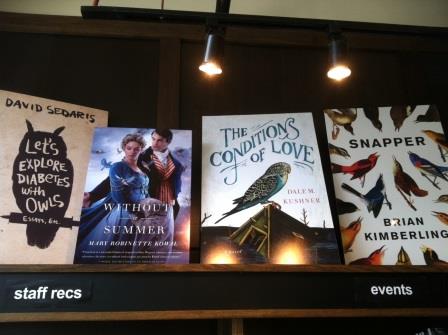
Stacie Spots Four Upcoming Novels with Birds on the Cover, All With Giant Posters.

Stacie put up some upcoming event signs and noticed that a whole bunch of them had birds, including:


a. Brian Kimberling, coming for Snapper on Thursday, April 25, 7 pm, at Boswell.
We love this book, but it's tricky for a first novel where the event is so close to the on-sale date but there's no family or friends component. Stacie designed a bird display to help promote the book.

Here's a recommendation from Hannah: "While reading Snapper, you get to know your new fictional best friend, Nathan Lochmueller. Why, you ask, is he so great? It's because he's a born storyteller! He's able to take all of the good, weird, and nostalgic times of life in Evansville, Indiana and make them the most compelling reading you never knew you were missing."

Of all the books listed, this is the most appealing to birdwatchers.

b. Mary Robinette Kowal, coming for Without a Summer on Monday, May 13, 7 pm.
Robinette blends speculative and romantic elements in a way that can intrigure folks interested in either genre. Jane at our store is reading this as a loyal member of JASNA (the Jane Austen Society of North America, to which Kowal also belongs), but another fan is Jim Higgins at the Journal Sentinel who wrote in 2012 "What impressed me most about this smoothly written novel is how seamlessly Kowal has woven the magic into the story, and devised a form of magic that fits the Ellsworths' world. The creating of illusions to make a mundane world more pleasant -- that's of a piece with the music and painting young women of this era were already learning."

c. Dale Kushner, author of The Conditions of Love, on Thursday, May 16, 7 pm.

From the publisher: "In 1953, ten-year-old Eunice lives in the backwaters of Wisconsin with her outrageously narcissistic mother, a manicurist and movie star worshipper. Abandoned by her father as an infant, Eunice worries that she will become a misfit like her mother. When her mother's lover, the devoted Sam, moves in, Eunice imagines her life will finally become normal. But her hope dissolves when Sam gets kicked out, and she is again alone with her mother. A freak storm sends Eunice away from all things familiar. Rescued by the shaman-like Rose, Eunice's odyssey continues with a stay in a hermit's shack and ends with a passionate love affair with an older man. Through her capacity to redefine herself, reject bitterness and keep her heart open, she survives and flourishes. In this, she is both ordinary and heroic. At once fable and realistic story, The Conditions of Love is a book about emotional and physical survival. Through sheer force of will, Eunice saves herself from a doomed life." Comparisons are to Elizabeth Strout and Mona Simpson.

Kushner's debut novel had the usual kind of conversation in booking it. She's a Wisconsin writer with a high profile release, so I did an inquiry, first checking to see if she had a strong enough family and friends base for a local launch. As she doesn't have a Milwaukee background, our next thought was to pair her up with another novelist, especially because we have a lot of debuts out this season, and there's something really great about two authors having a conversation, which always winds up happening during the question part of the talk. Our first thought was to pair her with Rebecca Kanner and have a flood theme (as Sinners and the Sea is about Noah's wife, and Kushner's novel also has a flood as a pivotal plot point). But being that we have flood warnings, I'm glad we didn't do this as it could have turned out not so great. Kanner is now reading with Joshua Henkin on April 30.

And then we looked to Andrea Lochen, a Wauwatosa writer who is coming out with The Repeat Year. Both authors have taught writing. They might have some interesting things to say to each other, particularly if it turns out there are plot or thematic connections that I haven't caught yet. This is a game you can play, by the way. Pair up any two books and try to imagine how you would link them together when making a sign.

d. David Sedaris, coming for Let's Explore Diabetes with Owls.
He'll be at Boswell on Sunday, May 26, 2 pm. You are probably wondering why we are doing this at Boswell, but the thing you need to know is that publisher events must be inside bookstores. All other events are run by an outside production company. Some stores around the country are doing book-with-ticket events, but ours is going to be a classic and free-and-open-to-the-public-no-ticket-or-book-purchased required extravaganza. Once we reach capacity, folks we'll have a signing line outside, much like we did for the Barrowmans in the fall. It's going to be crazy. If you like your Sedaris events civilized, he'll be coming back to the Pabst in the fall for a ticketed event.

We do have a few events coming up with tickets, however. Details to come.


Thursday, April 18, 2013

I'll Take Potpourri for $20 (More or Less, with Your 20% Discount)--New Boswell's Best in Assorted Categories.

My decision to wander around fiction, nonfiction, and kids' books is based on wanting to feature Frank Viva's A Long, Long Way (Little, Brown). If you don't remember Along a Long Road, that was a trip from here to there. The new book is up to down, or down to up, as the book can be read either way. An amorphous but very happy alien blob travels from space to the deep sea and back, with lots of alliteration and rhyme. A sample page reads "A boot, a bite, a left, a right" as he passes a whale, several stinging fish, a submarine, and yes a lost boot. New Yorker cover artist Viva also has a series of cards, which we've been pondering bringing in from Whigby.

Alas it's hard to find reviews on kids' books, soI have nothing to link to. So maybe I should continue on this Whigby track. There's also Frank Viva wrapping paper. Wouldn't that by amazing? And now I'm all excited about ordering the line in, and so I have of course misplaced the catalog. I don't think you quite are understanding how great this book is. Like his last, it is really one long picture, and because the book goes from up to down or down to up, it is best read sideways. Come in and we'll give you a demonstration!

Bob Staake is another popular New Yorker artist, whose past work has included The Red Lemon, a New York Times best illustrated book,  Look! Another Book!, which I wrote up on the blog last fall and for which watched several videos of Staake creating pictures, and The Donut Chef, which I remember well because it was about, well, donuts. Bluebird (Schwartz and Wade) is a wordless picture book that tells the story of a boy and his friend, a bluebird (am I too often stating the obvious in this post?) The story is done in grayscale, with blue highlights (and a little surprise at the end, of course). I am not usually one to tout computer animation (mostly because I see so much of it in self-published kids' books) but Staake can do a heck of a lot with circles and squares.

In fiction, I am drawn to Amy Brill's The Movement of Stars (Riverhead) mostly because it has that velvet finish which I like to rub when I'm sad. It's a historical novel set among the Nantucket Quakers of the 19th century, with young (for us, not for them) Hannah Gardner Price living a secret life on her rooftop, where she hopes to discover a comet. It's when she meets a whaler who she takes on as a student that her life begins to unravel. Based a bit on the life of Maria Mitchell, the first female astronomer in America, Brill is another writer exploring the seemingly hot area of women and science. Here's an interview with Brill in The Brooklyn Eagle, from the borough where writing is likely the largest industry per capita in the country.

Another new novel on the Boswell's Best is The Smart One, (Knopf) by Jennifer Close, whose previous work Girls in White Dresses was called an "irresistible, pitch-perfect first novel" by Marie Claire. Ah yes, Marie was just telling me about that. Stephan Lee in Entertainment Weekly thought Close's newest could be a story arc for season six of "Girls." He observes that "this bighearted novel examines a generation of nonstarters with a mix of empathy and Close's signature deadpan, pathos-driven humor"

And here's the Brant County Library speaking of new acquisitions at The Paris Star of Paris, Ontario: "No matter what your taste, or favourite genre, we are likely to have something for you" and Closes's newest was a the top of the list, though I must admit that the person who put it together seemed to use the same copy I did--Weezy's kids have moved back home and are falling into the distinctions that her own parents made about her and her sister "the smart one" and "the pretty one." I'm actually most interested in Christine Pountney's dazzling new novel, Sweet Jesus, only because there doesn't seem to by U.S. rights yet. You always want what you can't have, right?

The "smart one" would be particularly interested in our nonfiction this week, with Robert Alter's Ancient Israel: The Former Prophets: Joshua Judges, Samuel, and Kings (Norton) appealing to folks who like Elaine Pagels. I wish I could have hand-sold this to all the attendees at our recent event, but the book wasn't out yet! Alter's ongoing translation of the Hebrew Bible has won the PEN Center Literary Award for Translation. His newest volume is said to be an entertaining amalgam of sensational action and high literary achievement. Here's a Publishers Weekly article about the book's publication.

Christopher Clark's new The Sleepwalkers: How Europe Went to War in 1914 (Harper) tells how the crisis leading to The Great War unfolded, from the assassination of Archduke Ferdinand in Sarajevo to the beginning of the conflict that took the lives of 15 million people began just 37 days later. Clark is said to reveal a Europe racked by chronic problems, a fractured world of instability and militancy. I sometimes find that a lot of reviews of books like this wind up being plot summaries, in a way you would decry a review for taking a similar tack on a novel. But David Shribman in the Boston Globe does note that Clark "has done a masterly job explaining the inexplicable. The tragedy is that when trying to understand the 20th century, the inexplicable turns out to be indispensable." You can read the complete review here.

Wednesday, April 17, 2013

Local First Milwaukee + Maria Semple's "Where'd You Go, Bernadette" = A Fun Night on Wednesday, May 1, 7 pm.

As I’ve said time and time again, it’s harder for a comic novel to get traction in a literary marketplace. So that’s why I was particularly enthusiastic when Maria Semple’s novel, Where’d You Go, Bernadette, took the writing world by storm last fall. Carolyn Kellogg in the Los Angeles Times said it clearly. Like many writers, this book did not fall in her sweet spot, but “She has written a fantastic, funny novel. It’s affecting characters, not-necessarily-nice humor and surprising plot twists make this novel an enchanting ride.”

Semple already had a strike against her. She’d already had one unsuccessful novel published, and you must know it’s much harder to get the momentum going on a second novel when you’ve got unflattering numbers working against you. You’re not the hot young thing. Buyers look at your track when making their decision. And yes, the first novel, This One is Mine, had the Los Angeles curse, that weird thing where novels set in Southern California seem to perform worse than the equivalent book set elsewhere. Side note--we're featuring this novel on our Hollywood table, along with Jess Walter's Beautiful Ruins (appearing at Boswell May 6) and Paul McComas's Fit for a Frankenstein (appearing May 7, along with Dave Luhrssen for his Mamoulian biography)

That problem was fixed in Where’d You Go, Bernadette?, when the setting, like Semple herself, moved to Seattle. The only problem? Semple didn’t seem to really take to Seattle. I always think about that city as a city growing quickly, a siren song to the well-heeled, intelligent, and artistic. It’s every city’s dream to attract that kind of immigrant. But I also have at least one friend whose family has lived in the Queen City for over a century, and I know that it can also be an insular place, something that Semple is said to have sampled in her move.

And it shows in the novel. Bernadette and her family relocated from Los Angeles, and she’s retreated from civilization, hiding out in her shed, feuding with the neighbors, who are fellow parents at her daughter Bee’s school. Bernadette copes by getting a virtual secretary based in India, and slowly hands over the daily struggles of life (along with all her financial records) to Manjula. Meanwhile her husband Elgin is a high-profile exec at Microsoft (they wound up in Seattle when he sold his company to them), with lots of buzz from his high-profile TED talk, and in charge of a new top secret project. And what do you know that another fellow parent is Elgin’s new admin and seems to have developed a crush on him.

And Bernadette’s daughter Bee, making her way at Galer Street School, that hive of intellectual activity unfortunately located at an industrial park? Mom has plans to sent her to boarding school and get her out of Seattle, but Bee would want nothing more than a family try to Antarctica. It’s a frantic jumble, and the structure of the story plays on that chaos. I think you’d almost call this an epistolary novel, but taken to the next level, filled with emails, school memos, journals, doctor’s reports, and taped conversations. It’s craziness, but what less would you expect from a former write at the beloved television series, “Arrested Development.”

So the thing I need to tell you about Where’d You Go, Bernadette is that I was not an early reader on the book. I read the reviews, watched us chasing stock (and chased a little bit of stock myself) and heard the enthusiastic reads from others. And the reader crying the loudest among the folks I knew was my old colleague Nancy Quinn. She went gonzo for this book. Before the Buy Local Gift Fair, which Nancy helps organize each December, she sent a note to me, saying “Bring copies of Bernadette. I have to hand-sell this.” And she did.

When the paperback was announced and we were given an opportunity to host an event with Maria Semple (on Wedensday, Ma y 1, 7 pm), I wrote to Nancy right away. “We’ve got to have Local First Milwaukee co-sponsor this.” And yes, I wanted to harness the power of Nancy to make this an amazing event. It deserves nothing less. But it was more than that—this was a great novel to work on together. Where’d You Go, Bernadette really is about falling in love with your city. As much as Bernadette (and the author too) had trouble taking to Seattle, by the end (and I don’t want to give anything away here, so no details), the’ve got a totally different face on the place.

And that I think is part of what the Local First movement is all about, helping your place become the best place it can be, showing the love and support you can to make vibrant and sustaining and different. Nancy and I share that philosophy. I’ve always said that the thing about Milwaukee is expectations—for a lot of visitors, it’s nicer than a lot of folks expect it to be. Local First and all the other unique retailers who are a part of it (and nonretailers too, by the way) are part of that process.

Help the process along? If you’re an independent, locally-based business, maybe it’s time to join Local First Milwaukee. And if you’re a shopper, you consider moving over some of your purchases to your favorite indie retailer, or maybe you can step out of your box and discover a few indie retailers that you’ve never visited before. Could be fun. Lots more information on the Local First website.

Come celebrate the vibrancy of localness, Milwaukee and Seattle both, at Maria Semple’s event at Boswell on Wednesday, May 1, 7 pm, co-sponsored by Local First Milwaukee. Need more prodding? Here are some more reasons to come.

Where'd You Go, Bernadette? is named one of the six finalists for the Woman's Book Prize (fomerly the Orange Prize). Another is Kate Atkinson's Life After Life (coming to Milwuakee Public Market this Friday, April 19, 6:30 pm).

Janet Maslin praises Semple’s “free-range hilarity” in The New York Times.

Maria Semple speaks to Julie Bosman in The New York Times about the city’s reaction to the book.

Semple speaks to the “illicit thrill” of the epistolary novel on NPR’s Morning Edition.


Time magazine’s Lev Grossman names Where’d You Go, Bernadette? As one of the ten best novels of the year.

Yvonne Zipp in the Christian Science Monitor says Semple’s novel one of three outstanding novels of 2012.

And Susan Coll in The Washington Post says Where’d You Go, Bernadette is the literary equivalent of found objects.

We've got lots of upcoming events listed on this blog post. Get more details on our website.

Tuesday, April 16, 2013

Life's Highs and Lows, Compressed into a Tragic Day.

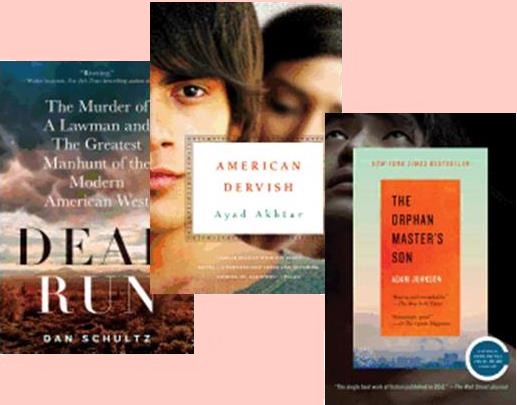
Yesterday was a day of emotional extremes. It was exciting to have a Pulitzer Prize in fiction again, and even more exciting that we'd hosted Adam Johnson for his novel The Orphan Master's Son, and that it was a really great event too, let alone a wonderful book with not one but several staff recs at Boswell (at least Jason and Conrad, in addition to myself). After a really strong sale in hardcover, I had been bemoaning a bit of a soft run in paperback. I think that trajectory has been corrected. Amie had noticed that for the past year, I had kept Mr. Johnson's kind note after our event on our office door. I knew I didn't file it for a reason.

Boswell has actually hosted two of the prize winners, as Ayad Akhtar won the drama award for his play "Disgraced," which Stacie had seen on a visit to Chicago and came back very enthusiastic. Akhtar didn't read from the play at Boswell, but from his novel, American Dervish, another book with multiple recommendations (in this case at least me and Mel, but I don't keep a complete checklist for these things).

And then of course there was the bombing at the Boston Marathon. I don't really understand what happened, except of course that it was an act of hate, and that we are shaken on several levels--empathy for the victims, a celebratory moment destroyed, not knowing how the degrees of separation will touch us, and of course as a reminder of our own fragility. I have several friends who work at the Boston Public Library--they were closed for Patriots Day, but they are both hard workers, and I worried.  I have one sister who's a runner (empathy) and another who lives outside of Boston (more).  Claudia recalled just being at the spot of the bombings last week. This of course brought back a memory of talking to my late father, who had similarly recalled to me having been being at the World Trade Center several days before those attacks.

It turned out our event last night was for Dan Schultz, whose written a book called Dead Run: The Murder of a Lawman and the Greatest Manhunt of the Modern American West. It is the story of three survivalists who, after a bloody killing spree in rural Colorado, were killed over the next few years by, well, who knows? They had a plot too, to blow up a dam, but in this case it was a failure. Though I've only read pieces of the book (can I admit here that I am reading as fast as I can, but I will never get everything I need to read finished?), but I am reminded a bit of the recent killings in Texas as well. They say that's a reason we read history--learn about the past to reflect on the present.

I think I'm going to wait until tomorrow to write about new releases. Our event schedule has a lot of unfinished business, and I should be working on an email newsletter as well.