![]()
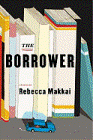
As you've been hearing from us, we're hosting Rebecca Makkai next Wednesday, July 20, at 7 pm for her new novel,
The Borrower. And if you happen to come across this blog afterwards, we hosted Makkai and it was great.
The Borrower is a novel about Lucy Hull, a children's librarian who winds up taking one of her young patrons across the country, sort of to save and and sort of because she can't figure out what to do with herself. Having graduated with an MLS (I have to assume this because we know write away she wound up at university library) with Russian emigre parents with grand dreams for her success (and some not-quite appropriate ways to get there), she's found herself in Hannibal, Missouri, or a near facsimile.
![]()
Her boss doesn't much care for her, but they've given her the children's librarian charge, since it seems to be the most work. Reading to children is exhausting! One of her patrons is Ian, a precocious youngster who'll read anything he can get his hands on. The problem is that his mother is very restrictive in what he'll read, with ground rules that exclude anything with magic, evolution, or adult content, for example.
There's a little backstory. Lucy's dad is a Russian emigre, who survived by working the system. That playful sense of morality has immigrated with him to the United States; you can see a bit of it in Lucy as well. She's also got two suitors--a self-satisfied musician named Glenn and a wheelchair-bound coworker named Rocky.
![]()
Lucy's sense of right and wrong starts to boil, however, when she realizes that Ian is going to Pastor Bob's summer camp, which are classes to fend off latent homosexuality and turn what seem like sissy pre-gay boys into manly heterosexual men. So when Ian decides to run away to the library, Lucy doesn't call his parents, and finds herself deeper and deeper, creating a house of cards based on her lies.
![]()
I mentioned in our email newsletter that in some ways the book reminded me of a female version of Dean Bakopoulos's
My American Unhappiness--a likable enough but somewhat deluded narrator, who makes a series of bad decisions that compound upon themself. I thought they should date, particularly because Zeke was rather desperate for a wife. I discussed this with Jocelyn while she was proofing, and she told me that in fan fiction this is called "shipping."
In the end, we never doubt that Lucy wants what's best for Ian. But can she save him? Well, I don't want to tell too much. but I think Rebecca Makkai's point is that books can save him, and there are many folks who can vouch for that. Sometimes I want to send an email to those kids on "Glee" and tell them they need to spend less time with their drama and more time in the library. It would probably get the show cancelled, but wouldn't it be better for the kids?
But really, what I must enjoyed were all the book references in the story I checked around with some quick searches to see if someone had compiled every kids book that went into the story. I'm still working on that.
![]()
a.
The Adventures of Huckleberry Finn, by Mark Twain--Makkai has mentioned that there are many plot parallels to the story. And the story is set in Hannibal, Missouri. And at the other extreme, the plot parallels...
b.
Lolita, by Vladimir Nabokov--In fact, the Penguin website notes that Lucy's name Hull comes between Huck and Humbert, and that her trevails bounce between the extremes of the two other narratives. I had no idea because...I have read neither book. Yes, true confession. How can I own a bookstore? I cheated on the BAT*. Lucy would understand.
c. The Borrowers, by Mary Norton--One has to believe the novel's title is an homage to the book about the tiny folk who live under the floorboards of a house. There is a lost boy subplot in the first book of the series.
d.
Charlie and the Chocolate Factory, by Roald Dahl--Several Dahl books are referenced several times, particularly The BFG, but the legendary chocolate factory that Lucy's dad refers to brings this title to the fore. It's another misunderstand young boy, and Lucy is filling in for Grandpa.
![]()
e.
From the Mixed-Up Files of Basil E. Frankweiler, by E. M. Konigsburg--Also referenced in the story, and the camping out in the library brought to mind running away to a museum. Lucy and Ian actually consider hiding out in a museum, until they decide that security has gotten a lot better since the 1960s.
f.
Where's Spot?, by Eric Hill--At first I thought the Where's Ian chapter was a reference to Where's Waldo, but the text didn't match.
g.
The Wizard of Oz, and sequels, by Frank Baum--Oz is apparently the ideal world for a boy who has trouble fitting in. Not only is there no romance, but there is even at least one case of a character changing genders. Oh, and it's a quest novel, just like this is.
One could keep going, and one should (
Charlotte's Web, for example, is referenced below), but the day awaits. Feel free to add any additional titles as comments.
Need more reasons to visit and get your copy signed? Here's the strong
Chicago Tribune review from Wendy Smith:
"In her bracingly tough-minded tale of a discontented librarian who hits the road with a maladjusted 10-year-old, Rebecca Makkai tips her hat to a shelf-load of children's literature, offering sly echoes of everything from
Charlotte's Web by E.B. White to
Where's Spot? By Eric Hill, while crafting her own distinctive sound in a first novel definitely not for kids. Makkai avoids almost all the pitfalls of debut fiction, including sentimentality and undigested autobiography, and though her plotting isn't as deft as her characterizations, the wonderfully nuanced closing pages more than make up for the occasional longueurs that precede them."
Read the rest of the review here.
And hope to see you at our talk/reading with Rebecca Makkai on Wednesday, July 20, pm. For a taste of her talk, read her
answers to frequently asked questions.
 Edward Janus, author of Creating Dairyland: How Caring for Cows Saved Our Soil, Created Our Landscape, Brought Prosperity to Our State, and Still Shapes Our Way of Life in Wisconsin.